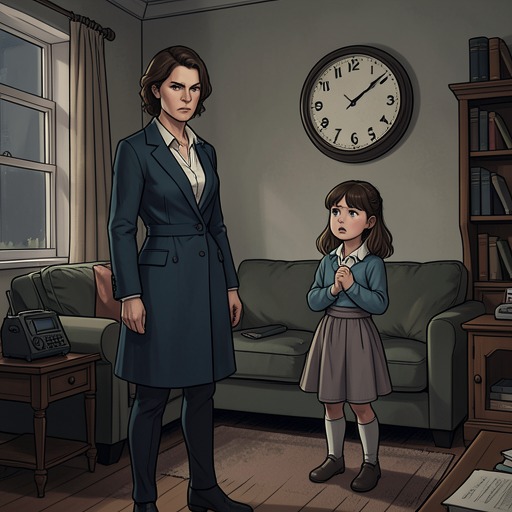
Bénédicte Ombredanne and Lola’s mother-daughter relationship
L'Amour et les ForêtsBénédicte Ombredanne and Lola’s mother-daughter relationship is shaped by a painful imbalance: Bénédicte devotes herself to her children, yet the care and discipline she provides increasingly become sources of conflict rather than closeness. Her efforts to protect Lola and secure her future collide with the pressures of an abusive marriage and with Lola’s growing independence. By the final period of Bénédicte’s life, the relationship has deteriorated into estrangement, while Lola appears more closely aligned with her father.
Care and Family Responsibilities
In the earlier pattern of family life, Bénédicte takes an active role in Lola’s education. Lola has been an excellent student, and Bénédicte supports that achievement by working with her on schoolwork each evening. She also sets expectations and enforces routines, responsibilities that, as her twin sister Marie-Claire later explains, include managing homework, deciding when the children go to bed, limiting outings, and setting standards for their performance. Bénédicte’s care is practical and sustained, but it also places her in the position of the stricter parent.
That work takes place within a household where Bénédicte is expected to carry much of the domestic and emotional burden. She describes herself as responsible for protecting, comforting, organizing, advising, and caring for the family, while receiving little acknowledgment in return. This account helps explain the pressure beneath her maternal role: her attention to the children is not simply affection but part of a wider, demanding pattern of service. Later, Marie-Claire recalls that Bénédicte continued to do the cleaning and ironing while undergoing chemotherapy, after the family stopped employing a cleaner during her first cancer. The exhaustion of maintaining the home and caring for the children intensified the rigidity that could enter her relationship with Lola.
The Day of the Secret Outing
The conflict becomes acute after Bénédicte spends a day away from home without telling her family. Lola is frightened by the unusual absence and by the anger that follows. When Bénédicte returns, Lola tells her that she fears the atmosphere at home and wants her father to stop shouting. She asks her mother to make the household happy again and worries that her father might hurt Bénédicte. Her alarm shows that the marital conflict has become part of the children’s emotional environment, not a private matter contained between the adults.
Lola also notices details that make her mother’s return seem unusual: Bénédicte is wearing her eye ring, her best dress, and her favorite boots. When Lola asks what happened, Bénédicte says that the day concerned her life as a woman and that children cannot forbid their parents from taking time to think. Lola counters that Bénédicte is also a mother. Bénédicte comes close to striking her, then stops herself, recognizing the disproportionate force that such a gesture would carry after years of devotion. The moment exposes the contradiction at the center of their bond: Bénédicte’s maternal sacrifice does not erase Lola’s fear or her anger at being left out of the day’s decision.
Bénédicte does not deny the importance of the outing. She tells Lola that she is glad she acted and that she will accept the consequences, while assuring her that neither Lola nor Arthur will come to harm. She also promises that they can speak again the next day and embraces Lola before sending her to bed. The tenderness is real, but it does not settle their disagreement. The secret outing has become a test of how much freedom Bénédicte may claim for herself and how much security Lola needs from her as a parent.
School, Adolescence, and Escalating Conflict
As Lola grows older, the mother-daughter relationship becomes increasingly strained around school and independence. From the autumn holidays onward, Lola’s results decline, and Bénédicte is distressed by what she sees as her daughter’s indifference to the change. Lola, meanwhile, begins to question the value of academic conformity and to imagine a life organized around other ambitions. Bénédicte recognizes the force of adolescence in Lola’s claims to individuality, but fears that rejecting school and its demands could leave her daughter with fewer choices. Her wish to protect Lola’s future therefore comes out as pressure.
That pressure becomes counterproductive. In one argument, Bénédicte pushes Lola to take school seriously and criticizes her attention to appearance and other interests. Lola experiences the exchange as humiliating and says that her mother is concentrating on her rather than dealing with her own unhappy life. Bénédicte, exhausted and distressed, responds with anger. Lola leaves, shutting doors behind her, while Bénédicte remains shaken and unable to repair the misunderstanding. The conflict does not end with the argument; the account describes days of coldness between them, during which Bénédicte feels unable to ask forgiveness or undo the harm.
Marie-Claire’s later recollection places these clashes in a longer family pattern. Bénédicte, she says, had become more rigid as she tried to meet her husband’s demands for an orderly home and exemplary children. At the same time, Jean-François retained the more appealing parental position and made Bénédicte appear despotic. Lola increasingly opposed her mother and identified with values she associated with her father. The result was a widening distance: the more Bénédicte tried to correct what she saw as risks to Lola’s future, the more Lola experienced her as an adversary.
Estrangement and Its Significance
The rift deepens as Lola reaches adolescence. Marie-Claire recalls that the relationship changed sharply when Lola, around thirteen, had her first boyfriend and became less engaged at school. Bénédicte thought her daughter too young for a settled romantic relationship and feared that Lola was sacrificing her future. These disagreements overlapped with Bénédicte’s first cancer and the fatigue of treatment, adding strain to an already difficult relationship. In Marie-Claire’s account, mother and daughter eventually came to hate one another, a culmination of competing expectations, accumulated exhaustion, and repeated conflict rather than a single rupture.
During Bénédicte’s final illness, the distance is visible in the family’s visits. Marie-Claire describes Lola standing apart or offering comfort to her father, rather than approaching her mother in bed. She interprets this as part of the broader alignment in which Jean-François had secured the children’s affection while Bénédicte carried the burden of discipline and household management. This is Marie-Claire’s retrospective explanation, and it does not erase the complexity of Bénédicte’s own conduct as a strict parent; it shows how the family’s roles helped shape the children’s loyalties.
The relationship thus binds care to conflict. Bénédicte’s devotion to Lola is evident in her sustained attention to school, household responsibilities, and her daughter’s future, but that devotion operates under pressure and can harden into control. Lola’s fear during her father’s outbursts and her later resistance to her mother are both part of the bond’s history. Its ending is not reconciliation: by Bénédicte’s final hospitalization, the mother and daughter have been separated by years of accumulated hurt, while the family’s competing versions of authority and care remain unresolved.